May 25, 2026 • Marlowe Finch • 9 min reading time • Specs verified June 4, 2026
The 12-Gauge Extension Cord Rule: Powering Your Projector Without Tripping a Breaker at 75 Feet
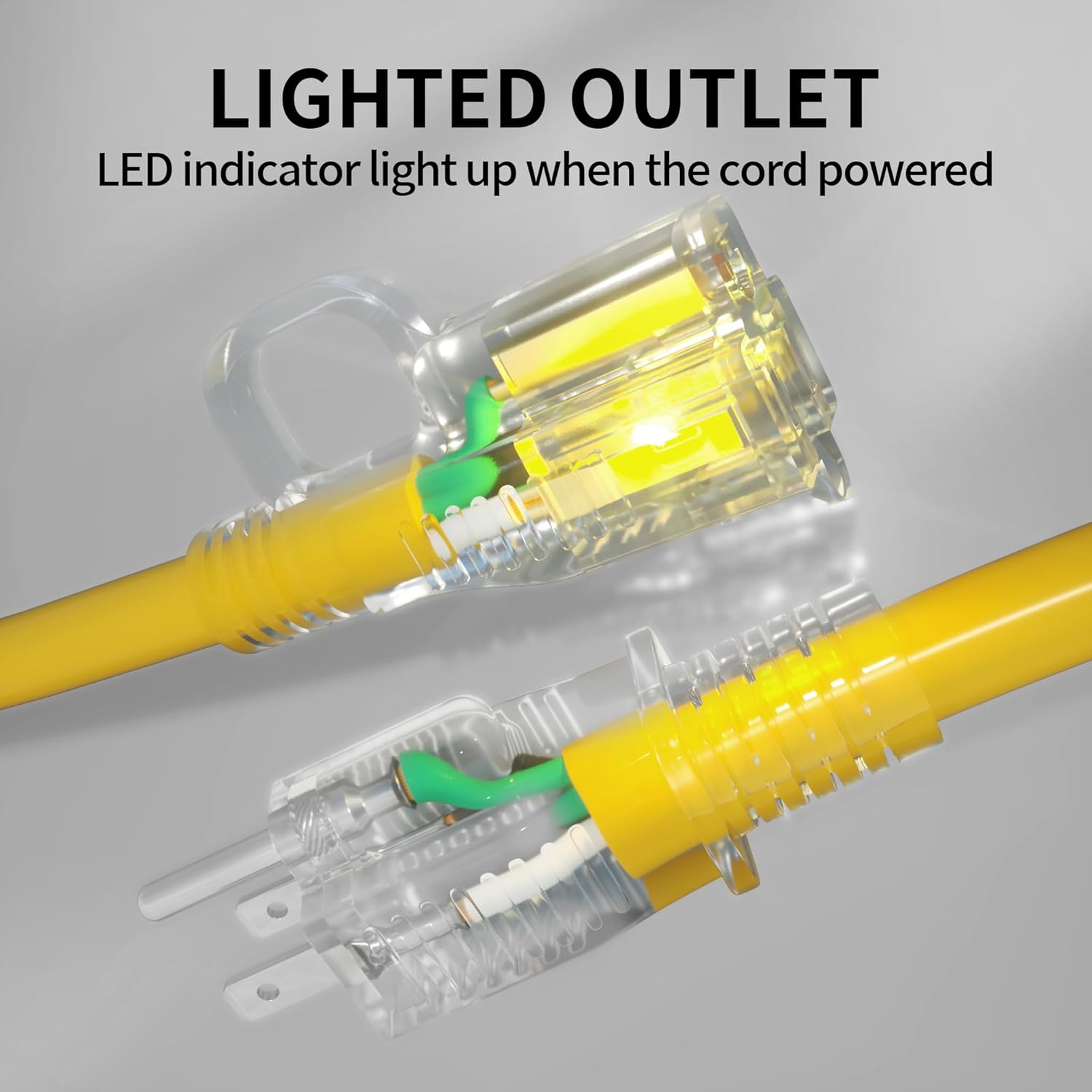
You set up your backyard screen, dial in the throw distance, and press play — then fifteen minutes into the opening credits, your outdoor outlet’s circuit breaker trips and the yard goes dark. Nine times out of ten, the culprit isn’t the projector itself. It’s the extension cord connecting it to your house. Extension cords are rated for a maximum amount of electrical current (measured in amps) that can safely travel through the wire. The thicker the wire inside the cord, the more current it can carry over a long distance without overheating or causing a voltage drop — a condition where the projector receives less power than it needs, producing flickering, shutdowns, or premature lamp degradation. Wire thickness is expressed as a gauge number: lower gauge means thicker wire. A 12-gauge cord handles significantly more current than a 16-gauge cord, and that difference becomes the deciding factor once you’re running power 50 to 100 feet across a yard.
This guide translates the electrical fundamentals into a clear decision framework: which gauge you actually need based on your projector’s wattage and your run length, what “outdoor rated” really means on a product label, and how to account for everything else drawing power on the same circuit during movie night.
| EDITOR'S PICK[PlugSaf 50 FT 10 Gauge Outdoor](https://www.amazon.com/dp/B0D6R927WG?tag=greenflower20-20)… | Mid-tier[POWGRN 50 ft 12/3 Outdoor Exten](https://www.amazon.com/dp/B0BMTJLMCK?tag=greenflower20-20)… | Budget pick[HUANCHAIN 12 Gauge Heavy Duty O](https://www.amazon.com/dp/B09WQNRN9P?tag=greenflower20-20)… | |
|---|---|---|---|
| Length | 50 ft | 50 ft | 25 ft |
| Gauge (AWG) | 10 AWG | 12 AWG | 12 AWG |
| Outlet count | 3 | — | — |
| Price | $69.99 | $40.99 | $26.48 |
| See on Amazon → | See on Amazon → | See on Amazon → |
Why Gauge and Length Are Inseparable
Here’s the thing most product listings won’t tell you: a cord that’s perfectly safe at 25 feet can become a fire hazard at 100 feet if you haven’t sized it up. Resistance — the friction that electricity experiences traveling through wire — accumulates over distance. The longer the run, the more resistance, and the more heat the wire generates trying to push the same current through. The National Electrical Manufacturers Association (NEMA) extension cord safety guidance makes this explicit: for a given load, you must increase wire gauge (decrease the gauge number) as run length increases, or you risk the cord operating near or above its thermal limit.
For projector use, the practical translation looks like this:
By the numbers — minimum recommended gauge by load and distance:
| Projector Draw | Up to 25 ft | 25–50 ft | 50–100 ft | 100–150 ft |
|---|---|---|---|---|
| Under 5 amps (~600W) | 16 AWG | 16 AWG | 14 AWG | 12 AWG |
| 5–10 amps (600–1,200W) | 16 AWG | 14 AWG | 12 AWG | 12 AWG |
| 10–15 amps (1,200–1,800W) | 14 AWG | 12 AWG | 12 AWG | Not recommended |
AWG = American Wire Gauge. Lower number = thicker wire = higher capacity. Source: This Old House extension cord sizing guidance and NEMA published tables.
Most backyard projectors land in the 5–10 amp band. The Epson LS800 ultra-short-throw laser is rated at roughly 280W (under 3 amps) in normal operation, per Projector Central’s power consumption database. A BenQ GP20 sits around 65W. Budget LED picos like the Anker Nebula Capsule draw under 30W. But the moment you add an outdoor Sonos subwoofer, a powered screen motor, and path lighting to the same run, your total draw climbs fast. If your cord has to feed a power strip serving the projector plus two Sonos Era 100 speakers plus a screen controller, you may be looking at 8–10 amps total — and that changes the sizing math considerably.
The 12-gauge rule of thumb in this article’s title is a practical default because it covers the realistic worst case for most backyard setups at typical distances (50–100 feet) without requiring you to calculate every device’s draw precisely. It’s a conservative, correct choice for the majority of situations. If your run is under 25 feet and your projector is a low-wattage pico, a 16-gauge cord is fine. But if you’re even mildly unsure, 12-gauge doesn’t hurt anything — it just costs a few dollars more and weighs more in your hand.
What “Outdoor Rated” Actually Means
This is where cheap cords earn their bad reputation. “Outdoor rated” is not a marketing term — it’s a specific set of requirements under the Underwriters Laboratories standard UL 817, which governs cord sets and power supply cords in North America. An outdoor-rated extension cord must have a jacket compound (the outer rubber or vinyl layer) that resists moisture, UV degradation, and temperature extremes. Indoor cords use a lighter PVC jacket that becomes brittle with sun exposure, cracks in cold temperatures, and is not rated for contact with wet grass or morning dew.
Look for these markers when selecting a cord:
- “W” designation in the cord type code — a cord labeled SJTW or SGOW contains a “W” indicating weather-resistant outdoor use. Indoor cords typically end in a type without W (SJT, SPT).
- UL listing mark — not just “UL Listed” as a marketing badge, but the actual UL mark with the specific standard number on the cord’s tag or molded into the plug housing.
- Three-prong grounded plug — projectors and AV equipment draw enough power that the ground wire (the third prong) is a legitimate safety element, not a formality.
Wirecutter’s review of the best extension cords notes that many budget outdoor cords sold at big-box stores carry a nominal “outdoor” label while using a jacket compound that degrades noticeably within two seasons of regular sun and moisture exposure. The editorial guidance there consistently points toward cords from established brands — Southwire, Husky, US Wire & Cable — whose UL-listed products hold up through multi-year outdoor use.
One more label to check: amperage rating. A 12-gauge cord is capable of handling up to 15 amps, but not every 12-gauge cord is manufactured to the same standard. The published amperage rating on the cord itself (often printed on the jacket every few feet) is the controlling number — not the gauge alone. If a 12-gauge cord is rated for 10 amps, that’s its ceiling in continuous use.
Circuit Capacity: The Variable Everyone Forgets
Getting the cord right solves only half of the equation. The other half is the breaker protecting the outlet you’re plugging into. Standard residential outdoor outlets in the United States are typically protected by a 15-amp or 20-amp GFCI (Ground Fault Circuit Interrupter) breaker — the GFCI is the safety device that shuts power off instantly if it detects current leaking to ground, which happens when a cord gets wet enough to create a shock hazard. That protection is genuinely valuable outdoors.
A 15-amp circuit has a safe continuous draw limit of 12 amps (80% of rated capacity is the standard rule for continuous loads under the National Electrical Code). A 20-amp circuit allows 16 amps continuously. If you’re running your projector, audio, a motorized screen, and maybe a low-voltage LED strip from the same outlet, you need to add the wattage.
A worked example: Epson LS800 (280W) + two Sonos Era 100 outdoor speakers at moderate volume (~60W combined) + Elite Screens motorized controller during raise/lower (~50W peak, brief) + LED path lights on a smart plug (30W) = roughly 420W steady-state, 470W at peak. That’s under 4 amps. A 15-amp circuit handles it easily.
Swap the Sonos Era 100s for a powered subwoofer like the Sonos Sub Mini (rated at 50W) plus two outdoor Sonos Amps powering passive architectural speakers (100W combined under real outdoor listening conditions), and you’re closer to 700–750W steady-state — still within a 15-amp circuit’s comfort zone, but meaningfully closer to the ceiling if anything else is shared on that circuit.
The scenario that trips breakers most reliably isn’t a single heavy device — it’s an outdoor outlet shared with a refrigerator or AC unit inside the house on the same circuit. Check your breaker panel before movie night. If the outdoor outlet is on a dedicated circuit (its own breaker), you have the full rated capacity. If it shares a circuit with interior loads you can’t predict, that budget is already partially spent.
Decision Framework: If X, Then Y
If you’re standing at a hardware store trying to decide what to buy, or comparing options on B&H Photo or Crutchfield before an event setup:
If your run is under 25 feet and total load is under 600W: A 16-gauge outdoor-rated cord (SJTW or better, UL listed, three-prong) is sufficient. Don’t overspend here.
If your run is 25–75 feet and total load is 600–1,200W: Buy 14-gauge as the floor, 12-gauge as the correct call if you want the same cord to serve your setup for years without second-guessing it. The price difference between a 50-foot 14-gauge and 12-gauge outdoor cord is typically under $15 as of mid-2026.
If your run is 75–150 feet: 12-gauge is the answer, full stop. Beyond 100 feet at projector-level loads, voltage drop becomes a real performance issue even with 12-gauge — if you’re regularly setting up at 125+ feet from power, a second outdoor outlet closer to the screen position is the right long-term fix, not a longer cord.
If you’re operating a semi-permanent installation — a dedicated backyard theater, a rooftop bar setup, a glamping tent with a permanent projector mount — the correct answer is to have a licensed electrician install a dedicated weatherproof outlet at the point of use. A properly run 20-amp circuit with a weatherproof in-use cover costs $150–$400 installed depending on run length and conduit requirements, and it eliminates every tripping-breaker, cord-management, and cord-degradation problem simultaneously. For venues and rental operators doing this repeatedly, the math clearly favors the one-time electrical work over replacing degraded cords and managing temporary runs event after event.
If your event uses a generator: Generator output varies significantly — a budget 2,000W inverter generator can safely power a 1,500W peak load, but projectors and AV equipment are sensitive to voltage fluctuation. Look for generators with inverter technology (Honda EU series, Yamaha EF series are the reference products in professional event circles) rather than conventional generators, which produce less stable sine waves. Projector Central’s guidance on power compatibility notes that most modern projectors include universal power supplies that tolerate moderate voltage variation, but laser-phosphor projectors can show brightness inconsistency with dirty power over long sessions.
The cable running across your lawn is easy to underspec because it’s invisible in the experience of watching a movie. But it’s the component that determines whether your setup runs without incident from opening credits to end credits — and whether it’s still in good shape for the next event, or cracked and weathered after one season. Twelve-gauge, outdoor-rated, UL-listed, three-prong: that’s the default. Anything shorter than 25 feet or lighter than 300W total gives you room to step down; anything longer than 75 feet at real-world loads pushes you toward a permanent electrical solution. Size it right once, and you won’t think about the cord again.