April 28, 2026 • Marlowe Finch • 9 min reading time • Specs verified June 4, 2026
Smart Projectors $300–$500: Where Official Apps and Real Brightness Finally Meet
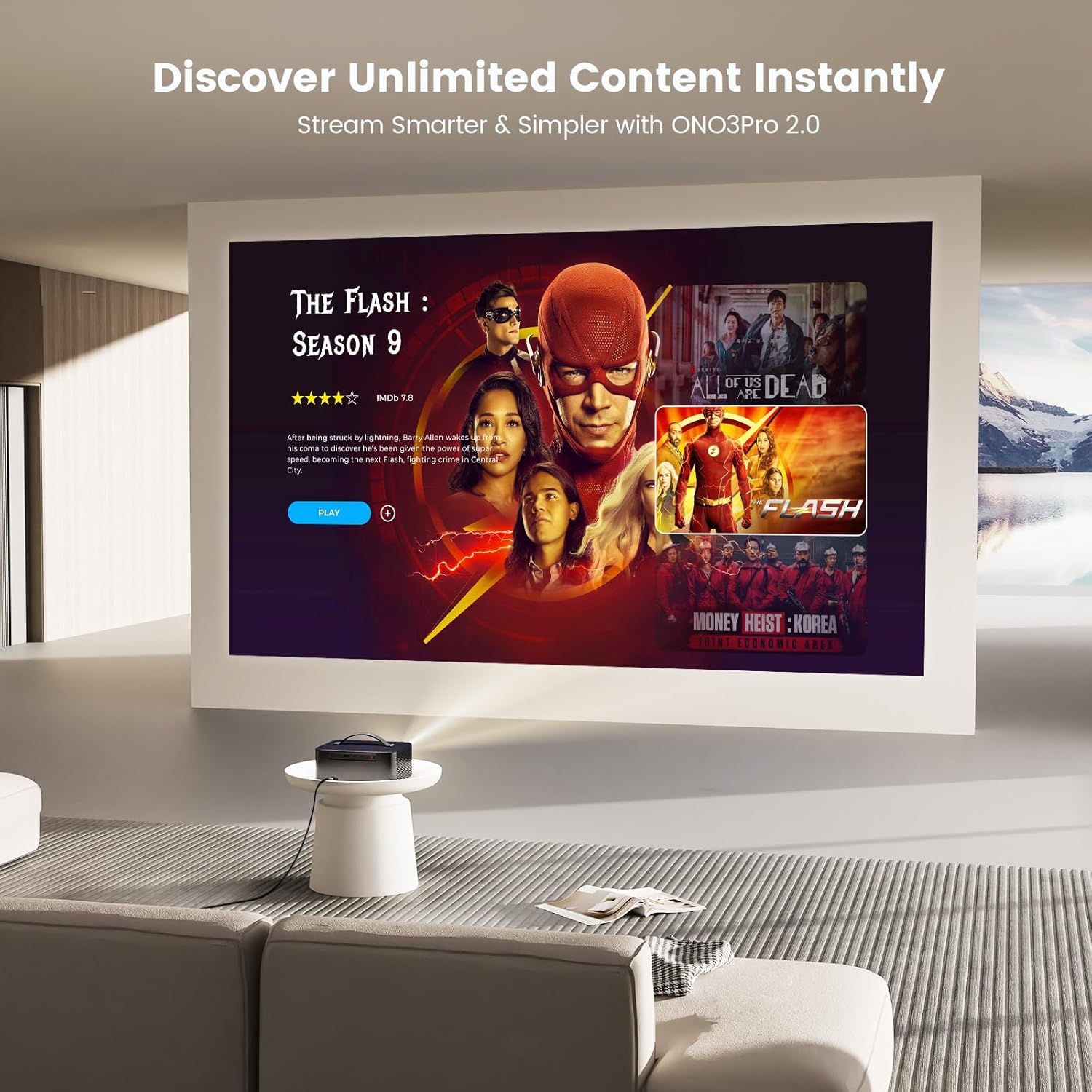
If you’ve ever bought a projector under $250 and wondered why Netflix wasn’t on it — or why it looked washed-out the moment the porch light came on — you’ve already identified exactly the problem this price band solves. A smart projector is one with a built-in operating system (usually Android TV or a proprietary variant) that lets you install streaming apps like Netflix, Disney+, and Prime Video directly, without plugging in a separate Roku stick or Fire TV. Below about $300, manufacturers cut corners on the operating system license and the light engine, which is the component that actually generates the image. At $300–$500, both problems are mostly fixed — but “mostly” is doing real work in that sentence, and knowing where the exceptions live is what this guide is about.
By the end, you’ll have a clear framework for reading spec sheets honestly, a short list of models worth considering, and a decision rule that maps your specific yard and use case to the right pick.
| EDITOR'S PICK[5000+ Official-Apps & AI Auto… | Mid-tierOfficial Licensed Google TV Sma… | Budget pick4K Projector with WiFi and Blue… | |
|---|---|---|---|
| ANSI Lumens | — | — | 3000 |
| Auto Focus | ✓ | — | — |
| Audio Power | 50W | Dolby Sound | — |
| Resolution | 4K | 4K UHD | 4K |
| Price | $299.99 | $269.95 | $239.99 |
| See on Amazon → | See on Amazon → | See on Amazon → |
Why This Price Band Is Different (and Where It Still Lies to You)
The Lumen Problem — Still Present, Just More Manageable
Lumen ratings on projectors are the most reliably inflated number in consumer electronics. The figure manufacturers advertise — often labeled “LED lumens,” “peak lumens,” or sometimes just “lumens” with no qualifier — is measured under ideal lab conditions that your backyard will never replicate. As Sound & Vision’s overview of projector brightness explains, the ISO standard for measuring projector output (ANSI lumens) is stricter and consistently produces numbers 30–60% lower than marketing specs. A projector advertised at 800 lumens may measure 350–450 ANSI lumens in independent testing.
At $300–$500, you’re mostly looking at true output in the 300–600 ANSI lumen range. That matters because outdoor ambient light is brutal. Here’s a practical anchor:
By the Numbers
- Dusk / full dark, no competing lights: 200–300 ANSI lumens is workable on a 100-inch screen
- Patio with string lights or a neighbor’s flood lamp: 400+ ANSI lumens needed to avoid a washed-out image
- Any residual twilight or a lit deck: 500–600 ANSI lumens is the floor for a satisfying picture
The good news: Projector Central’s portable projector buyer’s guide notes that the 2024–2025 generation of DLP-based portables in this price range has meaningfully narrowed the gap between spec and real output compared to earlier LED-only models, particularly among models using Texas Instruments’ DLP chip paired with an RGB LED light engine.
Android TV vs. Proprietary OS: Why It Matters for Netflix
This is the fork in the road that defines the category. Android TV (and its successor, Google TV) is a licensed operating system from Google. Projectors that carry it get the full Play Store and, critically, a version of Netflix that streams at full resolution with proper DRM (the digital rights management that lets you access HD content). Cheaper projectors often ship with AOSP Android — a stripped-down open-source version that looks similar but lacks official Netflix and frequently can’t access Disney+ or Prime Video at HD quality.
RTINGS’ reviews of portable projectors consistently flag OS licensing as the first thing to check, noting that several projectors in the $250–$350 range ship with Android 9 AOSP and no path to Netflix certification. If the listing doesn’t specifically say “Android TV,” “Google TV,” or “Netflix-certified,” assume it’s AOSP until proven otherwise.
The practical implication: at the low end of this band ($300–$350), you’ll see some AOSP devices that otherwise have decent specs. At $380 and above, Android TV becomes the norm rather than the exception, and a few models have begun shipping with Google TV, which adds a unified content discovery layer on top.
The Models Worth Knowing Right Now
Rather than a ranked list, here’s a comparison by the decision variable that actually matters — use case fit.
Best All-Around Outdoor Pick: ViewSonic M2e (~$380–$420 street)
The ViewSonic M2e runs Android TV, carries Netflix certification, and spec sheets put it at 400 ANSI lumens — a figure that Digital Trends’ portable projector roundup calls credible, noting that real-world image quality in moderate ambient light holds up better than competing models rated higher on paper. The auto-focus and auto-keystone (the automatic correction that squares a tilted image) work fast enough to be genuinely useful on uneven outdoor surfaces.
The battery life — rated at 3 hours — is the honest constraint. That gets you most movies; it does not get you a double feature or a long sporting event without a power cable nearby. Owners in aggregated reviews note the built-in speakers are adequate for a small group sitting close, but most serious setups pair it with a Bluetooth speaker. Form factor is compact enough to throw in a bag.
Skip it if: Your yard has meaningful ambient light past 9 PM, or you’re projecting onto anything wider than 120 inches. At that scale, the 400-lumen output will look thin.
Best for Larger Screens with Power Access: Optoma ML1080 (~$450–$499 street)
The Optoma ML1080 sits at the top of this band and represents a different set of tradeoffs. It runs a custom smart OS rather than Android TV — Optoma’s interface — which means Netflix works through a side-loaded workaround that Optoma officially supports, but it’s a less clean experience than native Android TV. What you get in return is meaningfully higher light output: spec sheets put it at 1,500 LED lumens (Optoma’s own unit), and independent analysis from Projector Central places calibrated output in the 550–600 ANSI lumen range.
That extra brightness is real and it shows on screen sizes above 120 inches in suburban ambient light conditions. It’s the model that makes a 150-inch backyard setup viable rather than aspirational. It does not have a battery — it requires AC power — which is a genuine constraint for anyone without an outdoor outlet or extension cord.
Skip it if: Portability and battery operation matter to your setup. This is a “set up in one spot and leave it” device, not a carry-anywhere one.
Best Value for Low-Ambient-Light Setups: Kodak Luma 350 (~$299–$329 street)
The Kodak Luma 350 sits just at the floor of this band and earns its place by offering Android TV certification at a price point where most competitors are still running AOSP. Spec sheets rate it at 350 ANSI lumens — conservative for the category, but reviewers at Digital Trends note that because Kodak is publishing a tighter spec number to begin with, real-world output is closer to the stated figure.
This is a genuine recommendation with a genuine condition attached: it is a dark-yard projector. If you have good light control — trees, a fence line, a late start time — it produces a clean, app-complete image. If you’re fighting any ambient light at all, the image softens faster than the Optoma.
AVS Forum’s mid-range smart projector megathread from 2025 has a useful thread on the Luma 350 where owners note battery life at 2.5 hours under continuous use, consistent with the rated spec.
The Hidden Costs That Change the Math
This is where a $399 projector becomes a $750 setup, and knowing the full number matters before you commit.
Screen: Projecting onto a white sheet or bare wall works at small sizes in full dark. For anything above 100 inches with this lumen range, a dedicated screen with 1.0–1.2 gain (the screen’s reflectivity rating — higher gain reflects more light back toward the viewer) makes a visible difference. Entry tensioned screens from Elite Screens or Silver Ticket start around $100–$150 for 100-inch fixed-frame or pull-up options.
Audio: Every projector in this range has built-in speakers rated at 8–12 watts. Outdoors, that sound dissipates quickly. A portable Bluetooth speaker in the $80–$150 range (JBL Charge series, Anker Soundcore) is nearly mandatory for groups of four or more. For a proper backyard setup, a pair of compact outdoor speakers wired to a small receiver gets you significantly further.
Streaming source redundancy: Even with Android TV, the built-in processor on $300–$500 projectors can lag when navigating menus or switching apps. Many owners keep a $35–$50 Chromecast with Google TV or Fire TV Stick plugged into the HDMI port for a faster interface, using the built-in apps only as a backup.
Power access or battery management: If you’re running the ML1080 or any non-battery model, a 50-foot outdoor-rated extension cord (~$25–$40) and a covered power strip are non-negotiable. For battery models, a 20,000 mAh power bank can extend runtimes by 1.5–2 hours depending on brightness setting.
The Decision Rule
Here’s the “if X, then Y” frame that resolves most decisions in this band:
If you have a dark yard (start time after 9 PM in summer, no competing light sources), a screen under 120 inches, and you want true portability with a battery → Kodak Luma 350 covers the base case at the lowest cost of entry.
If you have a typical suburban yard with moderate ambient light, a screen in the 100–130 inch range, and you want a clean streaming experience without workarounds → ViewSonic M2e is the balanced pick. The 400 ANSI lumen real-world output and native Android TV certification make it the most friction-free setup in the band.
If you’re running a screen above 130 inches, have consistent power access, and ambient light control is imperfect → Optoma ML1080 is the only model in this price range with enough real output to hold the image. Accept the OS tradeoff; the brightness premium is worth it at this screen size.
If you’re sourcing for a small event, vacation rental, or hospitality venue where the projector needs to be reliably hand-offable to non-technical users → the M2e’s clean Android TV interface wins on usability, but budget the full $750–$900 system cost (projector + screen + audio + power) rather than pricing the projector alone.
The $300–$500 band has genuinely matured. The gap between what manufacturers claim and what reviewers verify has narrowed. The Netflix certification problem is largely solved above $350. The remaining constraint is lumens — and now that the spec-sheet inflation is well-documented across Projector Central, RTINGS, and Sound & Vision’s independent analyses, you have enough signal to make a decision with your eyes open.