April 26, 2026 • Marlowe Finch • 9 min reading time • Specs verified June 4, 2026
Compact Laser Projectors Under $1,000: When Portability and Real Laser Brightness Actually Overlap
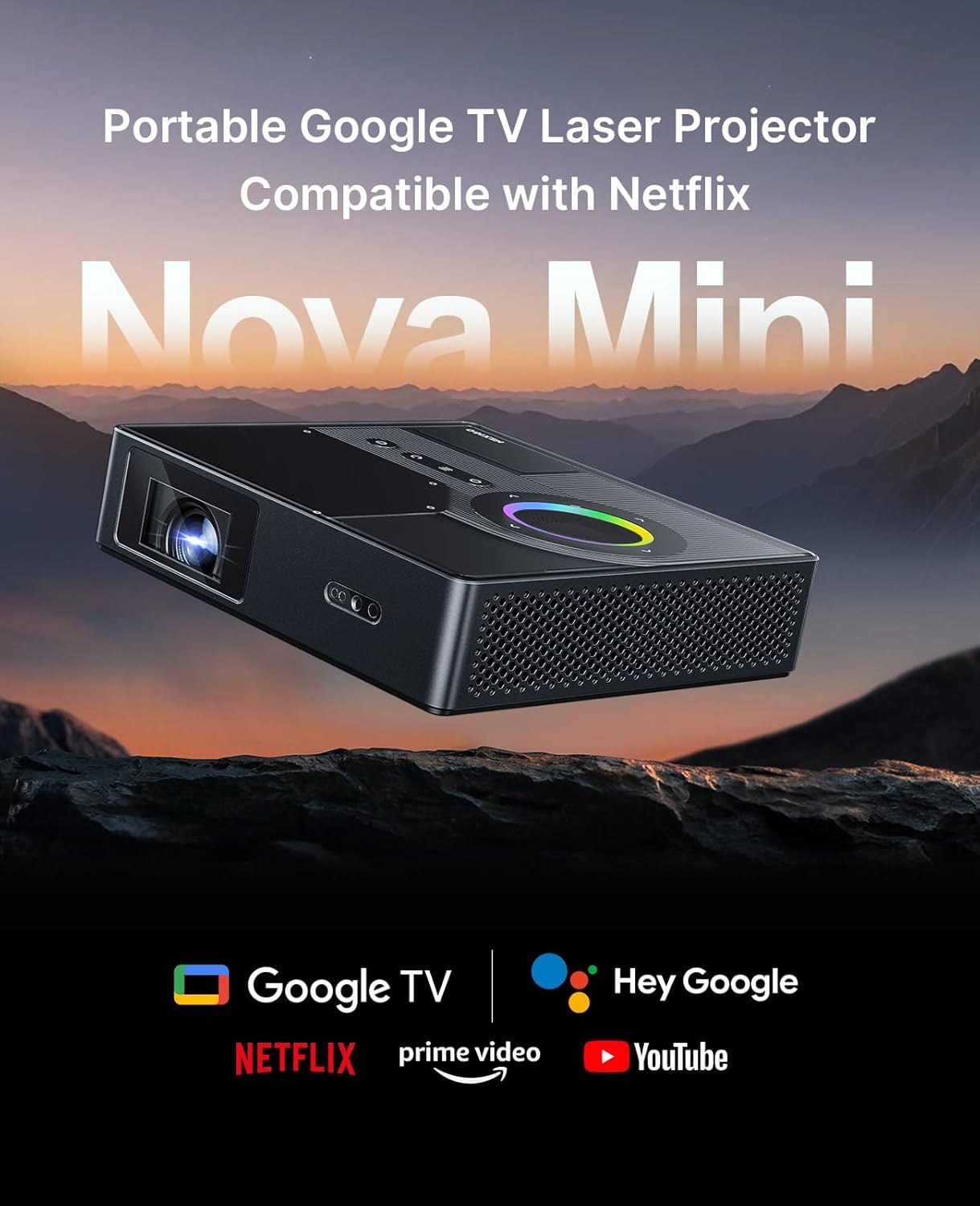
For most of projector history, “laser” and “portable” lived in different zip codes. Laser light engines — the internal hardware that generates brightness using laser diodes instead of a traditional lamp — produce exceptional picture quality and last tens of thousands of hours without bulb replacement. But they were heavy, expensive, and power-hungry. Meanwhile, portable projectors stayed small and affordable by using LED or lamp light sources that sacrifice brightness and color richness. In early 2026, that gap has meaningfully narrowed. A new cluster of compact laser projectors priced between $500 and $1,000 now promises both: genuine laser brightness and a form factor you can carry in a backpack or set on a picnic table. This guide breaks down what that promise actually delivers, which models are worth your money, and the specific conditions under which portability and laser quality genuinely overlap — versus the setups where you’re better off saving up or stepping down.
| EDITOR'S PICK[NexiGo TriVision Ultra](https://www.amazon.com/dp/B0DT9NTB34?tag=greenflower20-20) | Mid-tier[NEBULA Capsule 3 Laser](https://www.amazon.com/dp/B0BCWNQPQ7?tag=greenflower20-20) | Budget pick[JMGO N1S 4K Smart Portable Proj…](https://www.amazon.com/dp/B0DS64TTTN?tag=greenflower20-20) | |
|---|---|---|---|
| Resolution | 4K | — | 4K |
| Laser Type | Tri-LED-Laser | Laser | Triple Laser |
| Brightness | 2600 Lumens | — | 1100 ISO Lumens |
| Contrast | 100,000:1 | — | — |
| Built-in Battery | — | 2.5H | — |
| Smart TV OS | Fire TV | Google TV | Google TV |
| Price | $1,199.99 | $749.99 | $749.00 |
| See on Amazon → | See on Amazon → | See on Amazon → |
What “Laser Brightness” Actually Means in This Price Band
Before comparing models, it helps to understand what you’re actually buying when a compact projector claims a laser light source at this price.
The brightness spec problem. Manufacturers rate projectors in lumens, but the industry measurement standard — ANSI lumens — is routinely overstated in marketing copy for portable and mini projectors. Projector Central’s specs database consistently notes that manufacturer lumen claims on sub-$1,000 portable projectors often reflect peak brightness in controlled, low-ambient-light conditions, not the real-world output you’ll see projecting onto a screen in a backyard at dusk. As a rough working rule: expect usable brightness to land 30–40% below the headline number in typical outdoor conditions.
Laser versus LED versus lamp — what the light source changes. A laser light engine delivers higher peak brightness, better color saturation (especially reds and greens), and a dramatically longer operational life — typically 20,000–30,000 hours rated — compared to 5,000–15,000 hours for quality LEDs and far less for traditional lamps. Sound and Vision’s laser projector technology explainer notes that single-laser and laser-phosphor hybrid designs (the two types you’ll encounter under $1,000) differ in color volume: true RGB laser (three separate laser diodes) produces the widest color gamut, while laser-phosphor hybrids are more affordable but narrower in color performance. Most compact projectors under $1,000 use the laser-phosphor hybrid approach. That’s not a dealbreaker — it still beats LED for brightness and lamp for longevity — but it’s worth knowing so you’re not comparing apples to oranges when a spec sheet says “laser.”
The thermal ceiling. Laser diodes run hot, and managing that heat in a small chassis is the core engineering tradeoff in this category. Owners on AVS Forum threads devoted to compact laser projectors frequently report that runtime at peak brightness is limited — some units throttle output after 30–60 minutes to protect the light engine. For a 2-hour backyard screening, this matters. Check whether a model’s rated lumen output is a sustained figure or a peak-only spec before committing.
The Realistic Performance Window for Outdoor Use
Here’s where the decision frame gets practical. Not all outdoor use cases are created equal, and compact laser projectors under $1,000 genuinely perform well in some of them — and genuinely struggle in others.
By the numbers: lumen thresholds for outdoor screening
| Condition | Minimum usable lumens (ANSI) | Notes |
|---|---|---|
| Full darkness, screen 100” | 500–800 | Ideal; compact laser excels |
| Dusk / twilight, screen 100” | 1,000–1,500 | Manageable with gain screen |
| Ambient light (string lights, patio) | 1,500–2,000+ | Pushing limits of this tier |
| Pre-dark / early evening | 2,500+ | Outside compact laser’s range |
Most compact laser projectors in the $500–$1,000 band are rated at 700–1,500 ANSI lumens by manufacturers, which — after applying the real-world discount — puts sustainable output somewhere between 500 and 1,000 ANSI lumens. That’s a full-darkness or near-darkness tool. If your venue has meaningful ambient light — a rooftop bar with string lights, a glamping site where guests arrive before sunset — compact laser under $1,000 is not your solution. You’re looking at a different category: fixed-install short-throw laser starting around $1,500–$2,000.
Digital Trends’ portable projector buying guide draws a similar practical line, noting that mini and compact laser projectors “shine brightest — literally and figuratively — in controlled low-light environments” and that buyers expecting TV-quality images in mixed light will be disappointed regardless of the laser label.
Where compact laser earns its premium over LED portables. In genuine low-light conditions, the difference between a quality compact laser and a comparable-price LED portable is real and noticeable: sharper perceived contrast, richer colors (especially the saturated reds and greens in animated content and sports graphics), and more stable brightness over a 2-hour runtime. RTINGS’ projector review methodology notes that laser-sourced projectors maintain color consistency across the rated lifespan far better than lamp-based alternatives, and that laser-phosphor hybrids show measurably better color volume than similarly priced LED designs. For a family doing weekly backyard screenings in a low-light setting, or a vacation rental host whose outdoor movie setup runs after 9 p.m., that difference in image quality over hundreds of hours of use is meaningful.
Decision Frame: The Models Worth Considering
Rather than an exhaustive catalog, here’s a focused look at where the market actually sits in early 2026 and the decision logic for each tier within this $500–$1,000 band.
$500–$700: Laser-labeled but spec-check required. This is the most crowded and most misleading segment. Several models from Kodak, Dangbei, and XGIMI sub-lines carry laser branding but use laser-phosphor designs with real-world output closer to a capable LED portable. The Kodak Luma 350 sits at the entry edge of this range and reviews aggregated at Projector Central place its usable outdoor brightness in the 400–600 ANSI lumen range — strong for full darkness, marginal otherwise. The honest use case: backyard movie nights that start after dark, image size capped at 100–120 inches, paired with a white or low-gain screen. As a stepping-stone product, it’s legitimate. As a commercial-event solution, it falls short.
$700–$1,000: Where portability and real laser output actually overlap. This is the sweet spot the article title promises. Two models consistently surface in owner discussions on AVS Forum and in aggregated review coverage at Projector Central as the most credible performers in this window as of mid-2026:
-
XGIMI MoGo 3 Pro (street price approximately $749–$849): XGIMI has iterated meaningfully on thermal management compared to earlier MoGo generations. Owners report sustained brightness closer to the manufacturer’s 1,100 ANSI lumen rating than competitors at this price, with less throttling during long runtimes. The built-in Android TV operating system and auto-keystone/focus features reduce setup friction — relevant if portability is genuinely in use (different venues, temporary setups) rather than theoretical. Color accuracy reviews at RTINGS and in Sound and Vision coverage place it among the stronger performers in the laser-phosphor compact category.
-
BenQ GP10 (street price approximately $849–$999): BenQ’s compact laser entry point carries the brand’s reputation for color accuracy, and published spec comparisons at Projector Central show its color gamut coverage outperforming most competitors in this price band. The trade-off is a slightly larger chassis than the MoGo 3 Pro — it’s portable, but less pocketable. Owners in long-run AVS Forum threads note it holds brightness well over multi-hour sessions, which matters for event operators running double features or extended hospitality use.
The skip cases. Any compact laser under $1,000 with a single published spec number north of 1,500 ANSI lumens and no independent review corroboration should be treated skeptically. Projector Central’s methodology notes that sub-$1,000 projectors claiming 2,000+ ANSI lumens from a compact laser-phosphor design are almost universally measuring peak output under ideal conditions — not the sustained real-world figure. Don’t buy the headline; buy the corroborated number.
The Hidden Cost Stack (And Why It Shifts the Decision)
If you’re evaluating compact laser under $1,000 as a complete outdoor setup, the projector price is the starting point, not the finish line.
Screen. A bare white sheet or painted wall costs nothing and costs you significant image quality — especially with a laser source whose color accuracy you’ve paid a premium for. A basic fixed-frame screen from Elite Screens or Silver Ticket (100” diagonal, 1.0–1.2 gain) runs $120–$250 and is the single highest-leverage upgrade in any portable setup. For ambient-light environments where you’re pushing the projector’s limits, a low-gain ALR (ambient light rejecting) screen — which selectively reflects the projected image while absorbing off-angle room light — starts around $350–$500 for a 100” format. That’s a meaningful budget line.
Audio. Compact laser projectors at this price tier include built-in speakers rated at 5–10 watts. In a backyard or rooftop setting with any wind or ambient noise, that’s not enough. A portable Bluetooth speaker (Bose SoundLink Flex, JBL Charge 5) adds $120–$180 and transforms the experience. A proper outdoor speaker pairing — even a single-zone setup with a Sonos Move or Klipsch AW series — starts around $400 and represents the kind of investment that scales well for event operators and hospitality venues.
Power. Compact laser projectors run on AC power (most draw 60–150W). Outdoor setups require either a nearby outlet or a portable power station. A capable unit (Jackery Explorer 500 or similar) runs $350–$500. Battery-native projectors (the XGIMI MoGo line has a battery option) fold this in at the cost of reduced brightness during battery-only operation.
Realistic total for a portable laser setup that performs: $1,400–$1,800, counting projector, screen, audio, and power. That’s not a criticism — it’s the actual number you need for planning.
If X, Then Y: The Decision Rules
This category rewards honest constraint-matching more than most.
If your screenings genuinely start after dark and you need quality without a permanent install: compact laser in the $700–$1,000 band is the right call. The XGIMI MoGo 3 Pro or BenQ GP10 deliver a meaningfully better image than LED portables in this condition, and the laser longevity pays off over years of use. Budget the full $1,400–$1,800 system cost.
If you’re a hospitality operator or event coordinator running pre-dark or mixed-light screenings: step up. You need 2,000+ real ANSI lumens and a fixed-install or semi-permanent short-throw setup. The compact laser under $1,000 will disappoint your guests and your reputation.
If you’re deciding between a $400 LED portable and a $800 compact laser: the laser wins on image quality and lifespan if your conditions favor it (dark environment, regular use over 2+ years). If it’s a one-season experiment or occasional use, the $400 LED portable is the more honest choice — put the savings toward the screen and audio, which return more per dollar in the $300–$500 setup tier than the projector upgrade does.
If a model’s brightness claims haven’t been independently corroborated by Projector Central, RTINGS, or Sound and Vision: wait for the reviews. In this category, the gap between marketing specs and real performance is wide enough to change the decision.